I was tasked with making a photographic story about people at work. For the subject of my story I chose Elinor Brewer, who works with horses and runs an equine therapy social enterprise called ‘Maggie’s Voice’.
The Establishing Shot

I think this shot is better in colour because the colours of the sky and the general warmth of the sun comes through and gives the picture more character. Also in black and white, the sky would become for the most part just a white area, rather than a feature of the photo.
The Portrait Shot

This one could have been done in either B&W or colour, as not much here would have been lost in B&W, but I’ve done it in colour perhaps because I prefer the facial details more in colour rather than B&W. There is also the fact that the darker portions of the background could’ve seen degraded detail.
The Mid Shot

This shot was served much better by being in colour, the Autumnal colours of the leaves and the detail in certain aspects i.e the horse’s chin would have been lost in a black and white image.
The Close Up Shot

I like this image in colour, as it really brings out the detail in the fingernails, which tells the reader that this person has been doing work. Also the detail of the horses hair would not be so present maybe in B&W.
The Action Shot

This one would potentially have been better in black and white, as I feel the blue in the shirt is very distracting and B&W would have brought the entire focus back to what is actually going on. This coupled with the fact that there is nothing else really going on in the image to necessitate colour. As this is a series, I had to have it in colour or else he rest of the images would suffer.
The black and white shots, to me, seem more serious and fit the scene of a person at work. Also I feel that in black and white, an image can be appreciated more for what is actually portrayed to be happening in it, there are no distracting colours, no real hint at what time (of day or year) it is, and many other factors that aren’t necessarily important to the photo are eliminated. These things are not definitely bad for an image of this type, but some may feel that they want the bare facts of and image rather and any potentially unnecessary additions.
However, having said all of this, I chose to have my five images in colour because in this case I feel that a lot of the detail and colour that enhances the image is lost when black and white is employed.
The Journey
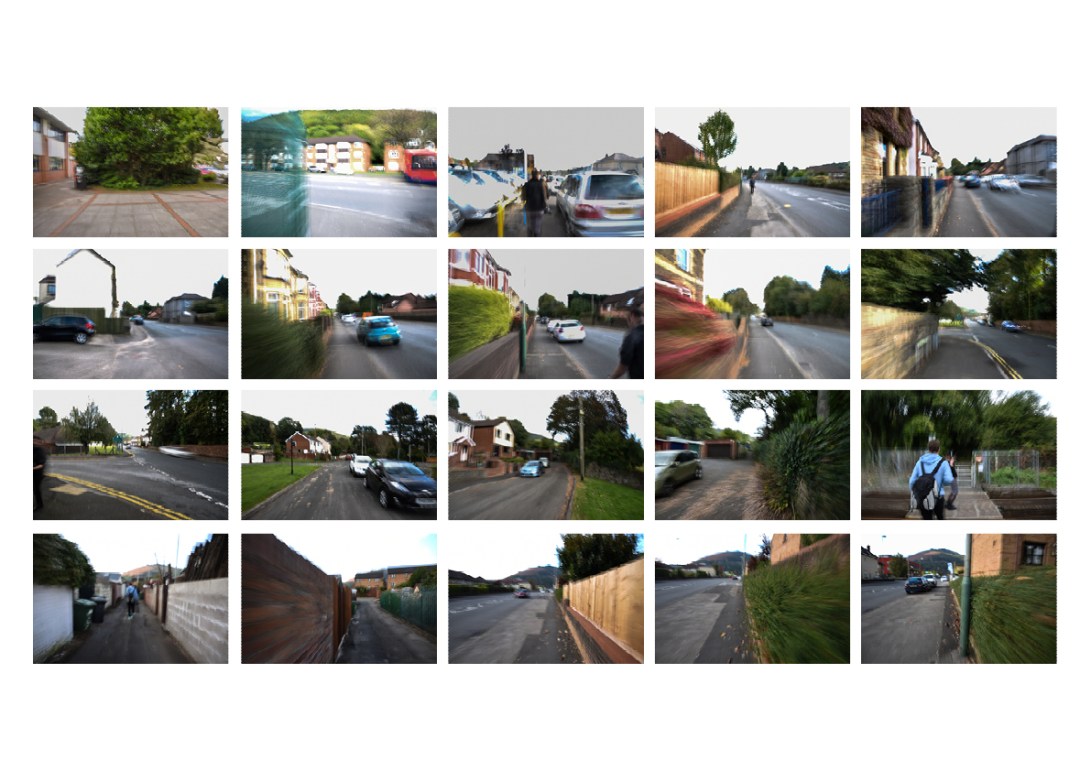 We went for a walk around Crosskeys and were tasked with finding an interesting theme to link all our photos together. I chose to use a slow shutter speed as I walked in an attempt to capture my forward motion. This worked to an extent (in some images more than others), I feel it worked better in the last four, as there is either a wall or a hedge on the side which is blurred in such a way that the desired motion is definitely apparent.
Lewis Hine
Born in Oshkosh, Wisconsin in 1874, he studied sociology at the University of Chicago, Columbia University and New York University. While teaching, he realised documentary photography could be a useful tool for social reform.
Steamfitter

This simple photo of a powerhouse mechanic working on a steam pump is very effective because apart from the fact it shows this man working in a very candid manner, the use of black and white is a good way of portraying the (I assume) bleakness of the job. With this being a very industrial line of work, it would be fair to assume that there isn’t a great deal of colour in this workplace anyway, but it drives home to the viewer this lack of vibrance. It is also noticeable how much bigger everything is than the worker, even the spanner is nearly the length of his arm, this emphasises the hugeness of the mechanical world he works in.
W. Eugene Smith
William Eugene Smith (30th December 1918 – 15th October 1978) was born in Wichita, Kansas was a photojournalist whose documentaries ranged from WWII to the city of Pittsburgh to a country doctor in the Colorado town of Kremmling.
The Country Doctor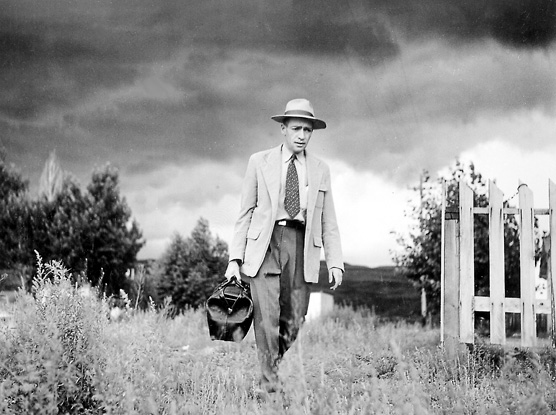 https://s-media-cache-ak0.pinimg.com
This image contains all the essential aspects of the photo essay, as it shows a man carrying a doctors bag walking through the countryside. The simple elegance of this photo makes it the perfect establishing shot for the series. The fact the photo is in black and white may signify the seriousness of his job and that on any given day he may be the difference between life and death.
 https://robc224.files.wordpress.com
This shot of the doctor at rest is particularly poignant, either in that the relationship that Smith had built with him meant that he didn’t mind being photographed after his presumably very stressful shift, or that he was so fatigued by his days work that he barely even noticed the presence of the camera. Whatever the reason, this is a very candid shot of the way in which the doctor would spend any precious seconds between his arduous working periods.
Chris Killip
Chris Killip was born on 11th July 1946 in Douglas on the Isle of Man. He is known for ‘The Isle of Man: A Book About the Manx’ and ‘In Flagrante’ among others.
In Flagrante
This was a collection of his work photographing the Northeast of England in the 1970’s and 80’s, it has a deeply cynical undertone and is staunchly on the side of the communities and people who had been forgotten by the Thatcher government of the time.
 http://www.telegraph.co.uk/culture/photography
Taken in Skinningrove, North Yorkshire, depicts the scene of what appears to be a mother and father, along with their baby and dogs selling crabs from a cart by the sea. To me this shows the futility of hard work at this time, as it is well known that the working classes got a very bad deal under the Thatcher regime, this is represented in this photo by the fact that they have a full cart of crabs, so obviously have worked hard to get them, but there appears to be nobody wanting to buy them, and by the fullness of the cart, few people have.
Lee Friedlander
Lee Friedlander is an American photographer and artist born on July 14th 1934.
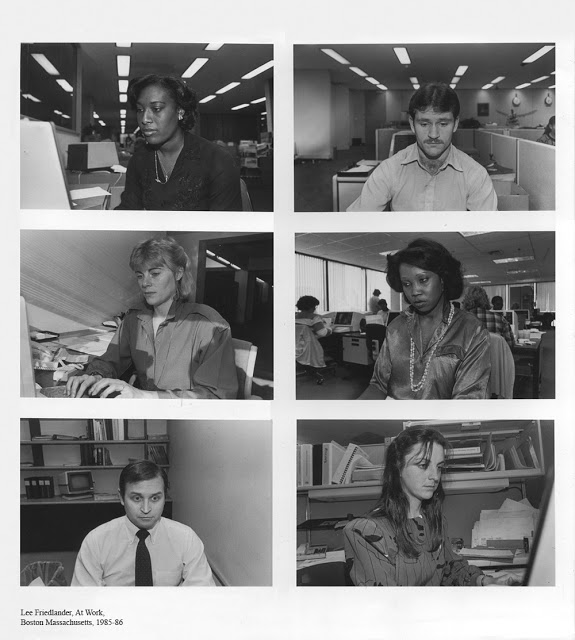
At Work
 https://thinkinpictures.files.wordpress.com
 http://emilyallenphotographyblog.blogspot.co.uk/
Some would look at these and see uninspiring, average, monotonous looking photos, however, I feel as though this was an artistic choice by Friedlander, who portrayed the blandness of the office work he was capturing in the style of the images and gave the viewer a sense of the drab nature of the environment. I think the use of black and white was particularly well utilised to show the colourless world these people inhabit when they are at work, and the similarities between each photo represent how nobody is special here, nobody is unique, they are all mere worker bees caught on the same rung of the corporate ladder.
Eddie Adams
Eddie Adams, born June 12th 1933 in New Kensington, Pennsylvania, was famous for photographing many politicians and celebrities, and 13 wars including the Vietnam War.
General Nguyen Ngoc Loan executing a Viet Cong prisoner in Saigon

This photograph won the Pulitzer Prize for spot news photography in 1969, and it is easy to see why such a shocking, some would say disturbing image would stand out among the sea of pictures. Here we see the last milliseconds of the life of Nguyễn Văn Lém, a captain in the Nation Liberation Front of South Vietnam, it is very rare that the anguish on the face of a person just about to be shot is frozen in time for all to see, this very effectively brings home the brutalities of war.
Mary Ellen Mark
Born in Elkins, Pennsylvania, March 20th 1940, Mark received a masters degree in photojournalism from the Annenburg School for Communication at the University of Philadelphia. Her work focused on the outsiders in life and was predominantly based on issues such as homelessness, loneliness, drug addiction and prostitution.
Streetwise
In 1983, Mark travelled to Seattle, Washington to do an article for LIFE magazine on runaway children.
 http://dazedimg.dazedgroup.netdna-cdn.com/
Mark cultivated a good relationship with her subjects, which, unless she was particularly daring, would be the only way to achieve a shot such as this. It may well have been staged, but it is a very real photo in that this is a daily reality for the kids she was photographing, living on the streets of a large city, they would obviously come into contact with and potentially feel the need to own a weapon. The juxtaposition of the supposed innocence of children and the instrument of death that one of them is holding is very striking.
The Florist
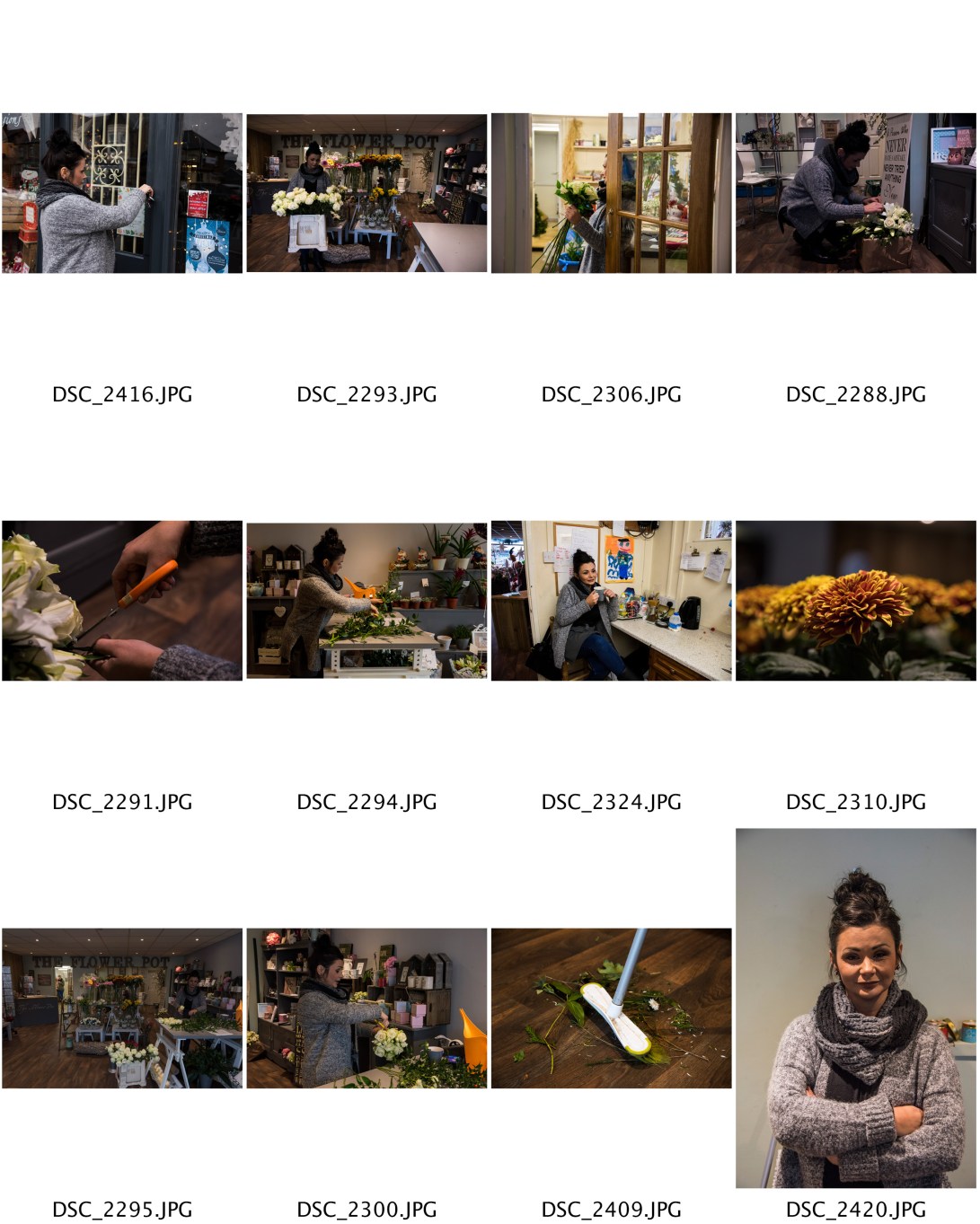
I decided to document a day in the life of a florist, so I headed to ‘The Flower Pot’ in Pontyclun. I feel I got some good shots, and accurately documented the day to day activities of the florist I shadowed.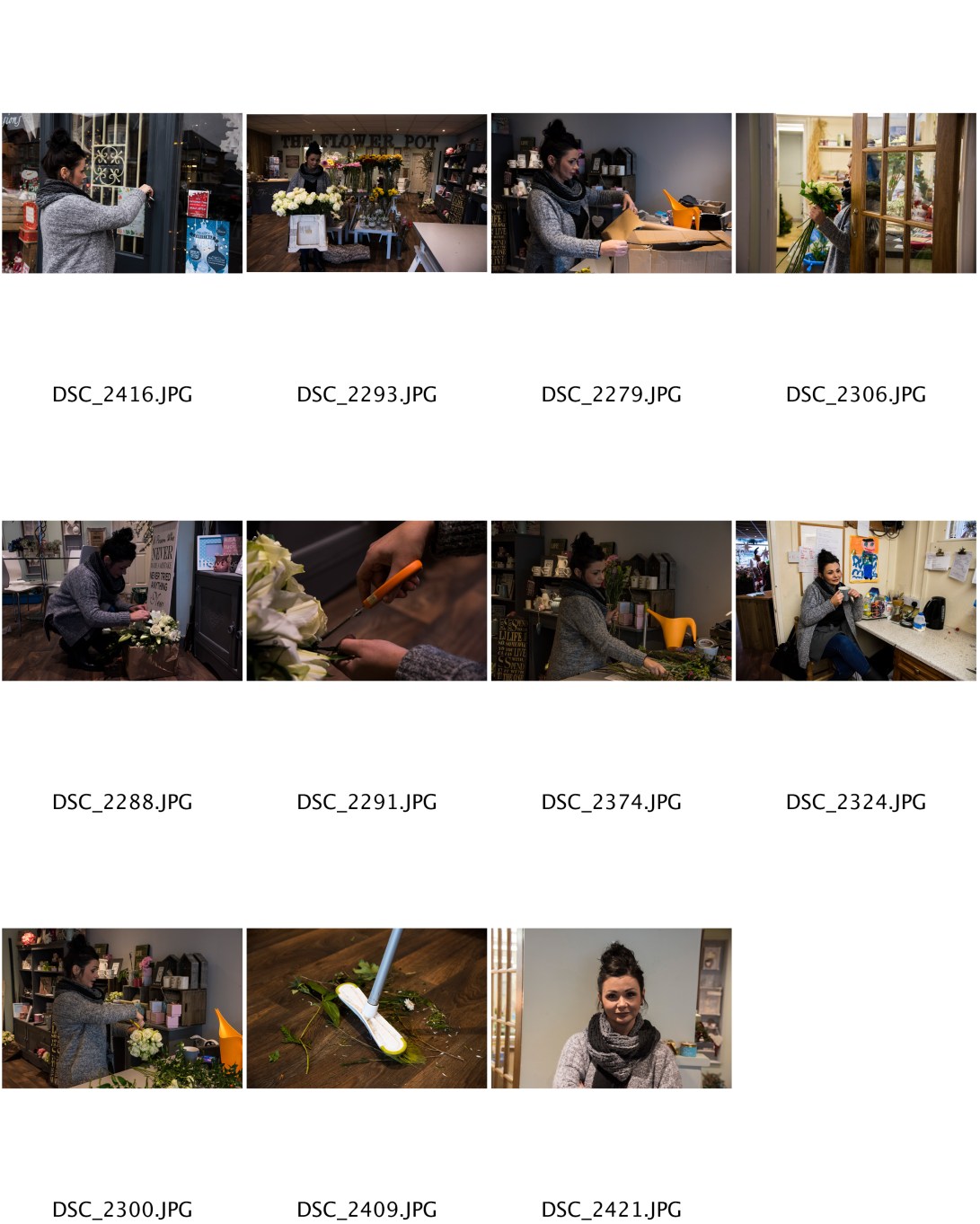
There are a few images of the florist at the work station preparing flowers at various stages, I was told that much of the time is spent doing this, so I felt it necessary to emphasise this aspect of her day. There aren’t any shots of customer interaction here, because although it is a high street shop, the large majority of their sales are orders and deliveries, so even if a customer had appeared during my time there I felt it would be a misrepresentation of what her work usually entails. As I said before, I feel I have accurately captured the working day of a florist, from opening up to sweeping away the floral debris after a long days work.
James Nachtwey
James Nachtwey is an American photojournalist and war photographer from New York, he has been present during many armed conflicts ranging from Iraq to Sudan and has received multiple wounds in the process.
Rwanda

This image depicts the mass burial of cholera victims in Rwanda. Apart from its obvious poignancy due to the huge loss of life shown, the contrast between the harsh mechanical digger in the background and the body delicately, peacefully resting on the blanket, almost as if they are just asleep on a hammock. This to me represents the individual beauty of human beings against the cold, uncaring powers that be.
The Flower Pot #2
After some consideration, I have decided to revamp my final submission to make it a more varied representation of the life of the florist.
Evaluation
Overall, I feel I achieved what I aimed for in this project, I captured what I feel were the most important aspects of the day in the life of a florist. I captured the moment that the shop opened, each part of the work day that I witnessed, from the work involved in the preparation of the flowers to the final bouquet, the phone calls for orders from customers, the well deserved rest period in the back room, to the sweeping up at the end of the day, and of course a portrait shot of the star of this documentary, the florist herself. Both the florists who were present on the day I dropped in were more than accommodating to my task, helped in any way they could and made me feel welcome and less like the burden I assumed I’d be, so for that I’d like to thank them. Some of the photographs I took were even used as advertising material by the owner of the shop, so I’d say this was a very successful project, and I got everything I wanted from it and gained a deeper understanding of what it is to be a be a documentary photographer.

