In This Module We Will:
Utilise the video aspect of the DSLR to create either:
A short documentary profile video of a person, including an interview.
A short piece of moving image that is influenced by the soundtrack. Should be photographic and aesthetically focused, not a music video.
A short “fashion film”
All should be between two and three minutes.
The films should include a title and ending credits, and use copyright free music or creative commons attributed so it can be displayed online.
Documentary Idea
I’ve recently booked tickets to see Gaz Brookfield in Bath, and upon learning of the nature of this module, thought it would be the perfect opportunity to try a documentary video that will hopefully be my final hand in. I’ve contacted both Gaz and the venue he will be playing at to ensure that they are both on board, and have heard back from both informing me that I will be allowed to film. My plan is to interview him before or after the show, with him talking about his musical career, life on the road and hopefully an amusing anecdote or two. I will alternate between this and footage of the gig itself with one of his song playing quietly in the background while he is speaking, then a little louder when he isn’t. I’ve sort of pre-visualised it in my mind’s eye and I really do hope it all works out.
Sum 41 Tour Updates
I’ve been a Sum 41 fan for years and so naturally check out their tour updates when they come out, and I’ve always noticed how well made they always are. So when the idea for what to do for my documentary video struck me, I already knew how I wanted it to turn out because of having this style of music documentary video ingrained in me for years. Obviously this is much more professional than I could probably hope to achieve, but as long as mine ends up something like this, I won’t have gone far wrong.
As much as this video is the kind of talking to music ratio I’m aiming for, the video below is even more cinematically impressive, and although filed in many locations over a lot of time from may different angles, something I am simply unable to do, I would like to attempt to emulate certain aspects such as the slow motion (although part of the conditions for filming was not to get in anyones way, so we’ll see how that goes…)
Idea Update
Unfortunately due to my lack of experience with using movie mode (and just general ineptitude), I was unable to remember how to switch the camera to movie mode during the gig and the subsequent interview. Very soon after the event, my brain finally kicked into gear and I worked it out. I shall not be repeating this particular mistake ever again.
Music Video Idea
As I am going to New York soon, I feel like it would be the perfect setting in which to shoot multiple brilliant locations. I have thought a fair bit about the type of shots I want to include, such as a sped up shot of the city’s busy traffic (hopefully including a few of New Yorks famous taxis), some out of focus then into focus shots of famous street signs, and some panning shots that have been slowed down in the middle as if to demonstrate the brief calm in the eye of the hurricane of activity that is New York. I plan to set it to the song ‘The Hands That Built America’ by U2, as I think it would fit perfectly with the imagery and the style of the video, it is also the end credits song in the film ‘Gangs of New York’, which is one of my favourite films of all time and has become intrinsically linked with images of New York in my mind.
The Beat of New York
Although a slightly different pace to the film I’m planning to make, this is still a very good place to draw inspiration from as it gives the viewer a real feel for the city. My video also probably wont be as people oriented as this one, but it is definitely an excellent example of a video set to music.
Central Park Cinematography
I may not be doing too much filming in Central Park, but this film contains a lot of the techniques that I plan on using, such as the fading in and out of focus of objects i.e the trees, the speeding up of the shots of people walking and the slow motion panning shots. The stability of most of the shots in this video are probably due to stabilisation equipment that I do not have access to (or just incredibly steady hands), but I am hoping for this level of smoothness throughout my video. I enjoyed it because it focuses on both the scenery of the park, and of course the people who bring it to life.
Experiment
We were tasked with shooting a short video during our lunch break, then have a go at editing it all together. I chose to document an average Tuesday lunchtime in the life of Kurt. This (as the video shows) involves a trip to KFC, and as trivial as the subject matter appears, it has allowed me to try out various effects and functions of Adobe Premiere. These include the slowing down and speeding up of clips, the razor tool to splice a clip in two so different effects can be use on each part (as demonstrated with the sped up and then slow motion chicken consumption scene), titles and fade out transitions. All of these I plan to use in my final film, so this exercise has been very beneficial to me as I now know what I’m looking for and how to use it.
Berlin Cinematography
I know this isn’t about New York, so won’t really inspire me with any locations to shoot at, but I think it’s still important to study the techniques used in this type of cinematography. The panning shots and short bursts of clips are what makes this video a good example of city cinematography. It gives the viewer a good overall view of Berlin and the kind of vibe it has, obviously this is influenced by the music, which is a lot more upbeat than the song I plan to use, so my video will have a very different tone.
My Final Film
Overall I am very happy with the finished product, there are obviously some areas that could have used some improvement, such as certain shots don’t quite have the motional consistency that others possess. Due to the subject matter however, I couldn’t exactly go back and re-shoot (however much I would like to), and I really didn’t want to switch ideas because I felt this one would definitely stand out and I’d been visualising it for weeks beforehand, and despite it not being exactly how I’d envisaged it, I still couldn’t bring myself to not hand it in. Apart from the bits that I’ve discussed that didn’t quite go to plan, there was a lot that went well with the film, such as the variety of places shown within the clips, as if I’d have simply stayed in the same area and shot then it would have become rather tedious after a while. Also towards the end of the video, the shots became much more professional looking and smoother for the most part, this is mostly during the shots of the 9/11 memorial, which I felt was pertinent that I dedicate a large portion of the video to, and I’m glad that the shots that came out best were the ones of such an important part of New York. I could have used a tripod for my filming, but overall I feel it would have hindered me more than helped, especially for certain shots such as the ones on the boat, due to the movement of the boat it wouldn’t have mattered if I had used one as there would’ve been movement in the shot regardless. For the most part I rested the camera on a flat surface to achieve stability, examples of this would be the sped up shots of various streets, Grand Central Terminal, and the traffic on the Brooklyn Bridge, which I feel worked quite well. I’m also very pleased with the shots that began out of focus and then went into focus, I think these were very effective and not overused, the Wall St sign clip could have been more stable, but I thought the shot of the 9/11 memorial graffiti was an excellent example of this technique. Even though it wasn’t supposed to be a literal music video, I also thought that some of the lyrical content of the song fitted in very well with certain scenes and generally tied everything together very well. The way the film ended with the American flag blowing in the wind and faded out just as it fully unfurled was very aesthetically pleasing and a strong way to end the video I think. I feel overall I have done justice to the way I pictured this film, and all in all enough went well to allow me to be satisfied with my efforts.
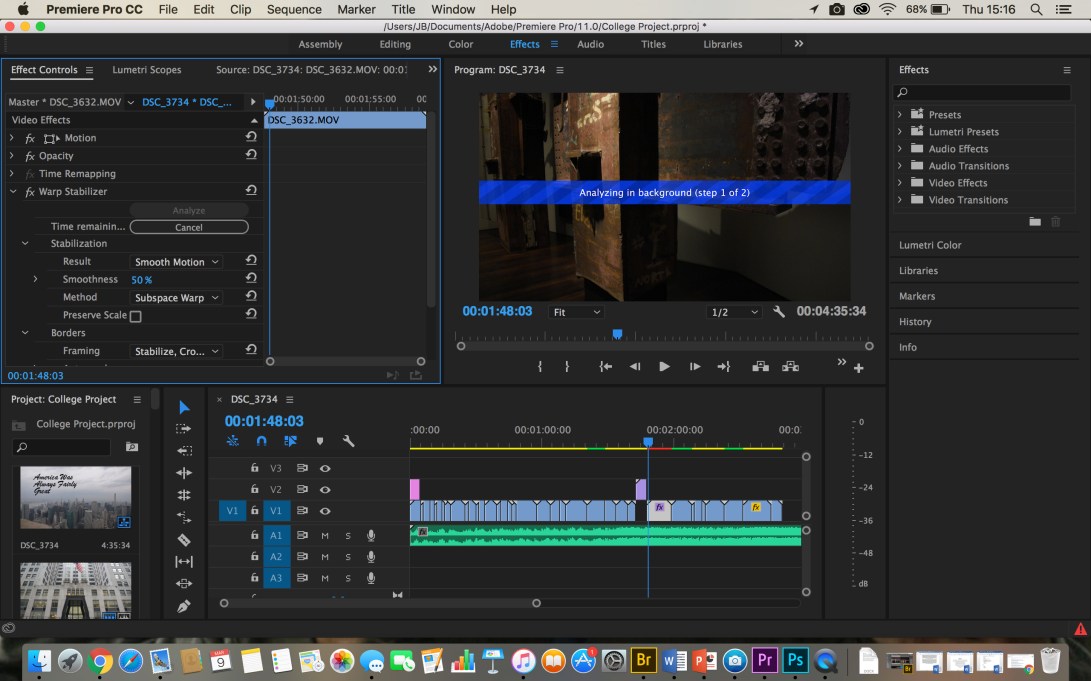
There were a few drawbacks in the editing process however, as when I used the warp stabiliser feature on certain clips, I did this to all of them in quick succession, and so it didn’t actually stabilise all the clips. Therefore when I exported my video, there were blue banners across half the clips telling me to press analyse, and after consulting with Dave, I realised that to solve this issue, I had to go into ‘effects’ and then ‘effect controls’, and only there would I find the analyse button that would make all my editing related problems go away. As time consuming as it was to keep exporting the video to find it marred with the blue banner, I now know how to deal with this issue if ever it happens in any future videos I make.
Subject and Sequence Evaluation
Part one of subject and sequence dealt with the basics of camera settings i.e aperture, shutter speed, ISO and how they all work together to determine what the final image will look like. Which, even though I was already familiar with them, was a very helpful module to hone the skills I already had and train me to think about each shot I take in terms of what settings will be needed to achieve the outcome I want. I feel my final product was a good start but if given the project again I would like to think I could create better imagery at this juncture.
In part two we were tasked to document the working day of one person in 10 – 15 images, I chose a flower shop near my house for the final hand in. Apart from being very pleased with my final imagery, I felt I learned a lot about taking meaningful photographs and the illusive ‘decisive moment’, which enabled me to instinctively know when to take shots in fluid situations involving people. This especially helped during my Valleys Archive project, in which taking these types of shots was essential to my series. I was also asked by the shop for my some of my images for advertising purposes, which gave me a certain level of confidence in my ability to succeed as a photographer.
Part three was Portraiture and Lighting, in which we created pastiche’s of famous portraits, took 20 street portraits, and took naturally and artificially lit environmental portraits. The pastiche and the environmental portraits were the two most challenging for me, as I’d never worked with lighting before, and has given me a greater understanding of how to handle both studio lighting and available artificial light in order to achieve the photograph I want. The street photography was a bit easier for me as I almost immediately came up with the concept I was going with (a slow shutter so the people in the background appeared to move while the subject remained still), which I felt went excellently. The actual approaching of strangers wasn’t particularly daunting as when I get in the right mindset, any social nerves seem to dissipate, this was also helped by the fact I had the camera as a buffer.
Finally part four, moving image. As discussed above, we had three choices, a fashion shoot, a documentary, and a video to music. After a few mishaps involving my lack of experience with video mode, I chose to do a video set to music during my time in New York. I feel this went very well, and I learnt a lot about the editing process using Adobe Premiere and would feel confident if asked to produce another film.
Overall these four modules combined have greatly enhanced my photographic and technical knowledge, and my instinct as a photographer as to what images to take and how to take them. I feel I have definitely learned a lot during these assignments and have grown as a photographer because of them.
 jb photography